

Every December, prediction season comes round, we get seven trends reshaping work, twelve things every CPO must know. Somebody dusts off a crystal ball and wraps it up in some beautiful slides, most predictions will be wrong. Some will be wrong with an impressive amount of confidence. But even a broken clock is right twice a day.
I have recently been reading McKinsey’s, PwC’s, and Gartner’s future of work reports, and what I find fascinating about these is that some of these predictions, myself and a few of us have been talking about since 2016 (experience and service design, value chains, product thinking and HR being an Experience Function)
The interesting question for me about the future isn’t what AI will make possible. It’s a more fundamental question around what we as an organisation decide is worth doing and, more importantly, who we want to become.
Rather than share another set of predictions for 2027 and 2028 (because nobody cares until PWC say it ten years later) there’s one decision I’d like to see organisations make before they even start to predict their future. Because I honestly believe we’re about to see what I call the great organisational divide.
Something that has less to do with technology than it does with the identity, ambition, and values we claim to stand for
The Great Organisational Divide
Most organisations have their values hung up everywhere from the canteen wall, the main entrance, and even in the toilets. Usually they sound like courage, care, curiosity, etc. Yet upstairs, the leadership team is looking at a slide saying that AI could run customer operations with far fewer people and the margin improvement would be amazing yet the value of care never got mentioned
By Friday that week it has a name Operating Model Optimisation
And we’ve managed to get there without once looking at the values that are hanging on the wall of the very meeting room where the decision was made.
Look, pretty much every organisation will adopt AI as will the people in it, this isn’t the divide I'm talking about. I think the real divide will be between organisations making fundamentally different choices about who they want to become.
Just to make this easier and (oversimplifying it) I like to see it as a bit of a spectrum.
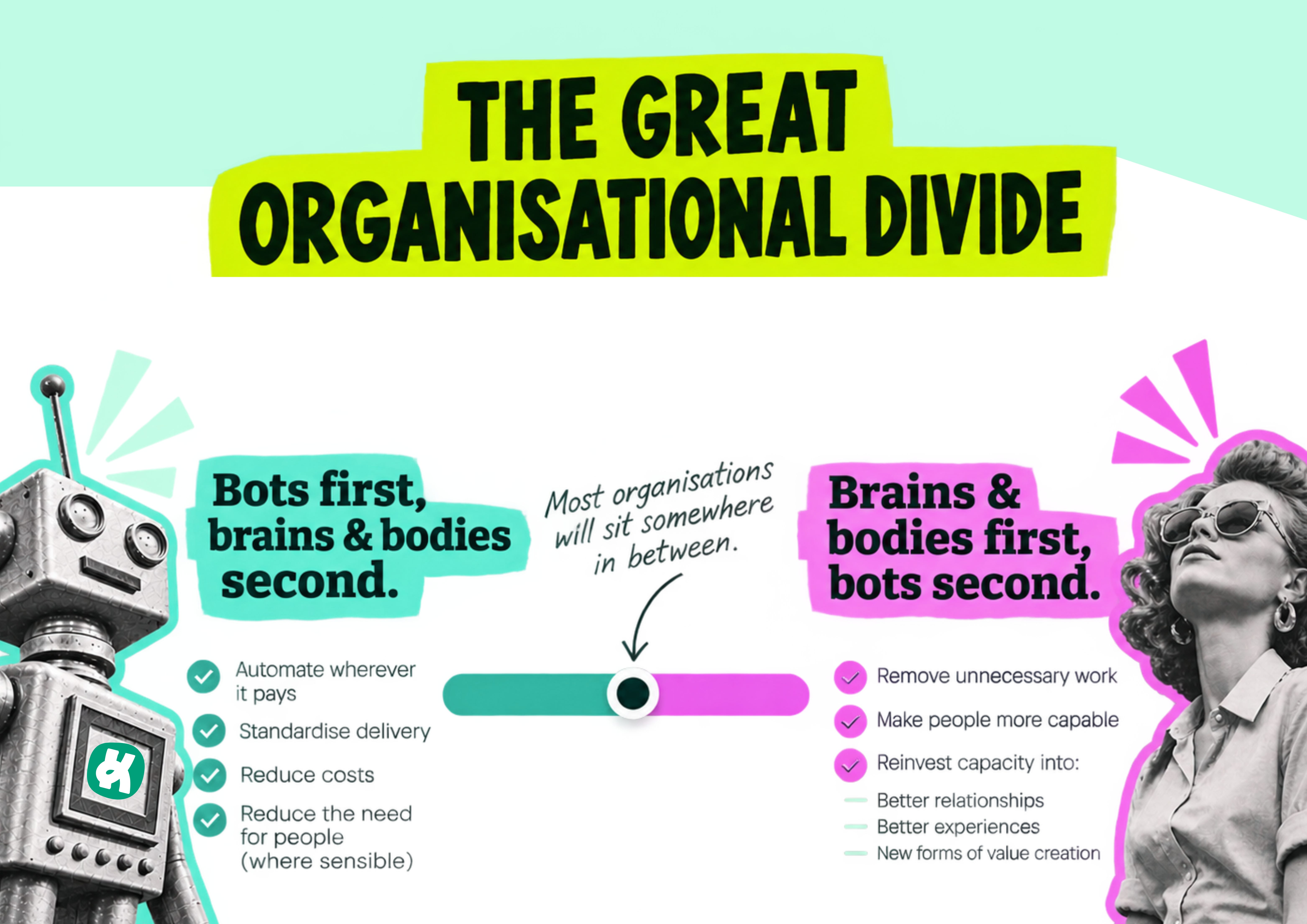
At one end of the spectrum, you have bots first, brains and bodies second. Automate wherever it pays to do so, standardise delivery, remove 10 seconds of queue time, reduce costs, and where commercially sensible reduce the need for people.
On the other end of the spectrum you have brains and bodies first, bots second. It’s about removing unnecessary work, making people more capable, and reinvesting some of that capacity into better relationships, better experiences and better identification of new forms of value creation for customers and employees.
Right now, we’re seeing some organisations lean heavily toward efficiency while also prematurely reducing headcount but I do think once this “Efficiency and AI Addiction” passes most organisations will settle somewhere between the two.
An organisation might be bot first in one part of its business and human first in another. What’s important isn’t having a fixed position on the spectrum, but having a consistent set of principles that guide both choices.
While both approaches are legit business strategies, they do create very different places to work and very different businesses to buy from. So, as an organisation, what guides your decisions along that spectrum?
I think this is where organisational values will finally earn their keep, beyond, like I say, decorating meeting rooms and filling the first 20 minutes of an onboarding.
I think, finally, we’ll see if the values we have proudly hung up everywhere match how the business makes difficult decisions and how well they are aligned to when two very attractive things compete.
AI could give you the opportunity to run your business with fewer people, you could bank the savings, improve the margins, and make your stakeholders super happy and your customer would barely notice any difference
Or you make another choice, which is that you invest some of that capacity into developing people who then focus on improving the customer experience, exploring new opportunities, and giving people some of their time back.
Both have merit, so what guides that decision?
Ultimately, it’s about asking some tricky questions.
If you say you’re a people-first organisation what does that mean when it costs money?
How much human connection are you prepared to sacrifice for margin?
Who gets the benefits of the value AI creates?
When does commercial ambition become commercial greed?
Notice none of these questions are about technology. They’re questions more about organisational identity and the choices we make as humans first
Our values and behaviours should help and guide those decisions and help us understand what we’re prepared to sacrifice. Those choices will determine where we sit on that spectrum.
I’m not suggesting every organisation should become human-first. Nor am I suggesting we preserve jobs that no longer create value doing that would be the quickest way to create Zombie Subscribers. Being bot-first doesn’t automatically make a business greedy, but it could start the Great Hollowing but I do think before we dust off the crystal ball and start predicting what 2027 and 2028 might look like, I’d rather organisations made a conscious choice about who they want to become, what they’re prepared to sacrifice, and who gets to benefit.
I’d also quite like to see those values hanging on the canteen wall play a part in that decision. Because if your values only apply when there’s no commercial downside, they’re not really values they’re just really expensive wallpaper