

I joined Zack Hamilton on his podcast Unf*cking Your CX we ended up discussing a few different things from our obsession with efficiency to why personas are as useful as a chocolate teapot most of the time. We also discussed the ideas of friction being bad and how the real value of an experience is time capital not money.
Anyway here the shorter version of it tweaked from the transcript… but I recommend checking out the show
We’ve become addicted to efficiency
If there’s one thing making me cringe in experience design right now, it’s our AI and efficiency addiction
We’ve become obsessed with making today’s experiences 1% or 2% better.
faster check-in.
One less click.
Automate a human interaction.
Reduce the queue.
None of those things are horrificly bad, like nobody has ever stood in an airport security queue wishing it moved a little slower.
The problem is that we’ve started confusing efficient experiences with valuable experiences.
One hotel introduces automated check-in, so another hotel introduces automated check-in One airline adds a digital feature, so everyone else follows.
Eventually, everyone is borrowing the same best practices, implementing the same technology and solving the same problems in roughly the same way.
The experiences start to look a bit like walking in a McDonalds
I call this Best-Practice Blindness.
You become so focused on keeping up with everyone else that you stop asking a more fundamental question like What experience are we actually trying to create?
There’s another question I think gets missed completely when we introduce the over indexing on automation What does the customer lose if we automate it?
We’re very good at calculating what the business gets back.
Fewer people needed
Lower costs
Shorter processing times
More customers served.
But every efficiency creates an exchange something changes for the customer too.
I saw this while doing an experience diagnostic with a hotel in London.
They were incredibly proud of their new digital key.
Guests could check in online, bypass reception, go straight to their room and unlock the door with their phone.
On paper, it was seen as being this beautiful thing, less waiting, less effort and faster check-in
So part of my experience diagnostic is walking the experience as a customer… so I did just that
They sent my digital key in the app before arrival…
Cue train cancellation a bust aircon on one of the trains I arrived from Manchester to London around 10.30 at night absolutely knackered
I went straight upstairs to room 508, pulled out my phone and tried the digital key.
Nothing.
I turned around to head back downstairs and discovered I couldn’t get into the lift either you guessed it, because the key didn’t work.
The thing designed to remove friction had actually created more of it
But that wasn’t the most interesting part.
The hotel thinking reception was a transaction that could remove was now undermanned at the time of need
The reception isn’t a transaction its a liminal space that helps the transition between being a traveller and becoming a guest.
It here where someone welcomes you, reassures you and answers any questions like where to go for breakfast, what time things happen and what you need to know the time little big thing going on in your mind where your knackered and been traveling all day
A two-minute interaction can be doing far more work inside an experience than a process map suggests.
That’s the danger of optimising something before understanding what it is really doing for the customer beyond a transaction.
Stop designing for personas. Start designing for situations and states
For years, we’ve designed experiences around personas.
The busy mum.
The business traveller.
The digital native.
The silver surfer.
Catherine, who likes cats, shops at Walmart and has somehow ended up representing 300,000 customers.
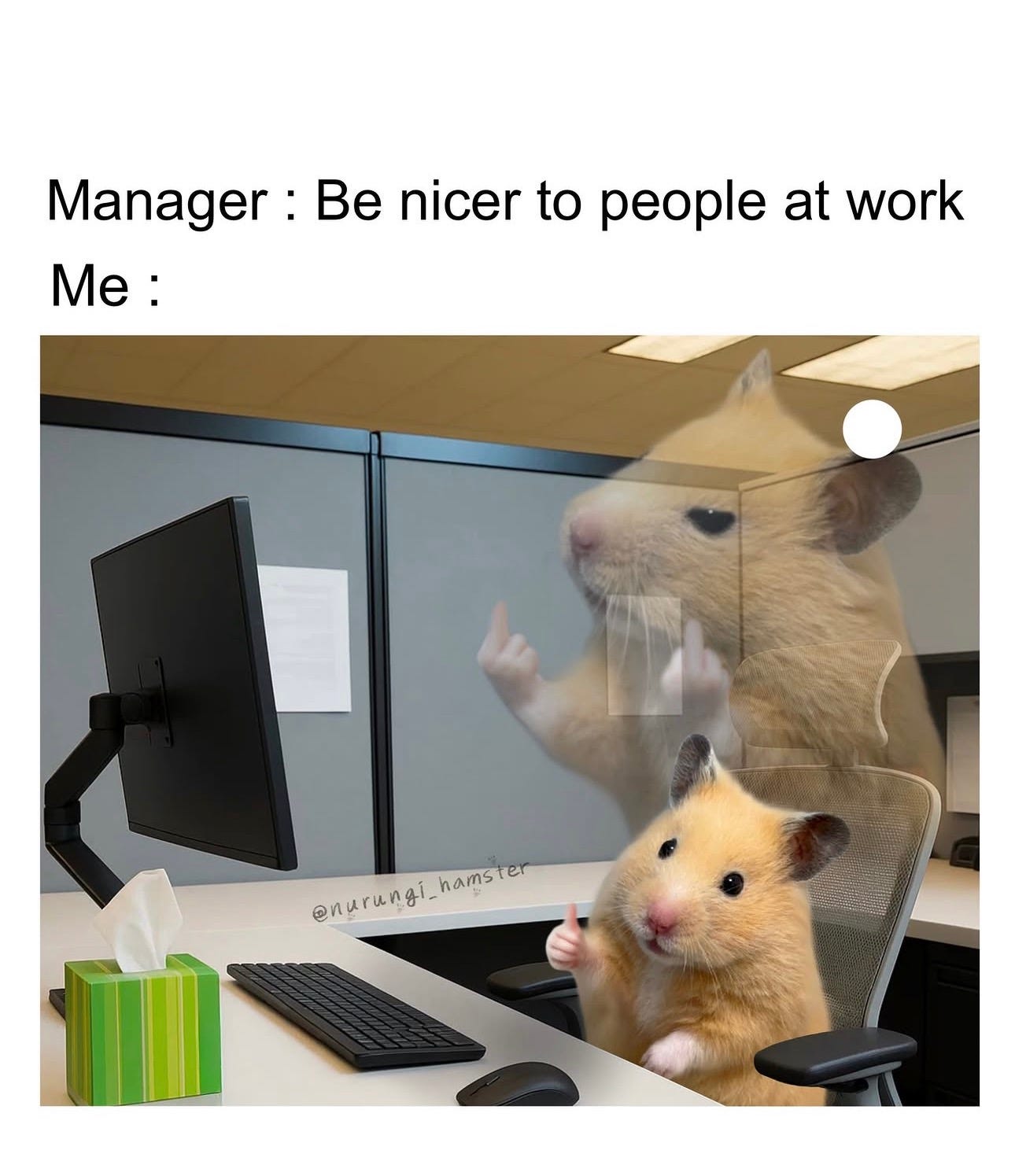
I love Irani food, red pandas and hamster memes (see below) but unless your gonna use that to elevate my experience its not valuable in the context of the experience.
The problem is that people don’t behave according to a persona.
They behave according to the situation they are in and the state that situation creates.
Imagine the same person taking the same train several times during one week.
Monday, they’re heading home after work.
Tuesday, they’re travelling to a final interview.
Wednesday, they’re connecting with a flight.
Saturday, they’re travelling to their daughter’s wedding.
Same person same train completely different situation in the experience
Their needs change because their situation changes.
Missing a train on Monday might be annoying.
Missing it when you’re travelling to your daughter’s wedding is something else entirely.
The same thing happens in airports.
You might be an experienced traveller who knows exactly where security is, which terminal you need and how long everything normally takes.
Then your incoming flight is delayed you’ve had three hours’ sleep dry swallowed two whole eggs from Pret and your connection leaves in 45 minutes.
You haven’t suddenly become a different demographic.
Your state has changed
When you start looking at experiences through situations rather than simply personas You start finding markets hiding inside the journey.
I call these Opportunity Markets.
Take rail disruption.
Most operators naturally see disruption as a problem to fix get people moving again, process compensation and reduce the inconvenience.
But imagine looking at the situation differently.
What becomes valuable to someone precisely because disruption has happened?
Maybe when booking your train you could buy enhanced journey protection lets call it the travel co-pilot
If disruption happens, your travel co-pilot automatically finds another train, coordinates a uber if needed, protects connections and helps you get where you were actually trying to go.
Now the operator isn’t simply selling transport from A to B.
They’re selling protection around the situation.
That is a different market.
And it was sitting inside the existing journey all along.
People give you more than money. They give you time
There’s another currency running through almost every experience is Time.
Most organisations measure time from their own perspective.
How quickly did we process the customer?
How many minutes did we remove?
How long was the queue?
How quickly did somebody complete the transaction?
That makes sense when time is something the customer wants to save but that isn’t always the case.
Sometimes people want an experience to be over quickly (getting a cavity filled at the dentist) sometimes slowing things down creates more value (getting my teeth cleaned)
And sometimes you can’t reduce the time at all, but you can change how that time feels.
Hospitals are a good example.
An A&E department can’t always magically turn a one-hour wait into ten minutes.
But it can change what that hour feels like there is a huge difference between knowing:
“The current wait is around 60 minutes.” vs sitting there wondering whether you’ve been forgotten and not knowing how long it will be to be seen
The clock is moving at exactly the same speed but the experience of that time isn’t.
We see the same thing in airports, contact centres, restaurants and queues.
Uncertainty stretches time and information can compress it.
So instead of only asking:
How long did this take?
I think we should also ask:
What did someone get back in exchange for the time they gave us?
That is what I mean by Time Capital.
Sometimes the job is to save someone’s time.
Sometimes it is to make their time feel better.
Sometimes it is to make that time worth spending in the first place.
Those are three very different design challenges but thinking in minute and moment can help you look at it through different lenses
Friction isn’t always the enemy
Which brings me to friction.
I’ve lost count of how many conferences, keynotes and articles I’ve seen telling organisations to:
Remove friction.
Some friction absolutely should be removed.
Forms nobody understands. Broken links. Repeating the same information to three departments. Processes that make customers wonder whether the organisation actively dislikes them.
Get rid of it.
But friction itself isn’t automatically bad think about airport security again
Most of us would like it to be quicker for sure, but imagine turning up tomorrow and discovering there was no security at all.
No checks scanners nothing you could just walk right through
You probably wouldn’t walk through thinking:
What a wonderfully frictionless experience.
You’d start wondering whether getting on the plane was safe and wise
That friction in the security is doing something important
It creates reassurance, care and give weight to the experience
The same principle applies elsewhere.
Sometimes a conversation that looks inefficient on a process map is actually reassuring someone.
Sometimes having a person involved creates trust.
Sometimes waiting builds anticipation.
Sometimes an extra step tells someone that what they are doing matters.
So the useful question isn’t:
Does this experience contain friction?
It’s:
Is this friction creating value?
Because when we remove friction without understanding what it is doing, we can create something I talk about a lot: Experience Leak.
Operationally, everything looks great .
Queue went down
Transaction completed
Digital key was issued.
Yet somewhere inside the experience, value disappeared.
And I think that connects all four ideas from the conversation.
Efficiency isn’t the problem.
Personas aren’t useless.
Speed isn’t bad.
Friction isn’t good.
The problem starts when we optimise any of them without understanding the experience we’re trying to create.
Sometimes the biggest opportunity isn’t making what already exists a little faster.
It’s noticing the value we’ve been designing out of it and how that value is what drives experience as a subscription for our customers and employees