


This week, I'm handing the newsletter over to my good friend Vaughen Broderick. Our paths crossed many years ago when we both were in the Innovation space.
We had a conversation recently about why good ideas die inside organisations, and it stuck with me. The piece below is the result of that thinking. If it resonates, know that I contributed to the book sitting behind it, Innovation in Action (Wiley, July 2026). Pre-order at innovationinaction.com it's worth it.
Today’s Focus:
Ideas don't fail at ideation they fail at implementation, which most frameworks quietly ignore.
Building a coalition is a design challenge, and asking "who else belongs in this room?" early changes everything.
The real cost of stalled innovation isn't a missed deadline, it's people stopping believing change is possible here.
TL;DR: Most innovation processes are brilliant at generating ideas and weak at making them land. The piece below shows you what to do about the half nobody else talks about.

Why Innovation Stalls After The Workshop
You know the feeling.
You've just wrapped up a workshop. The insights are gathered from actual humans, not assumptions in a boardroom. The team is energised and ideas are flowing. The stakeholders are nodding. Someone says, "This is exactly what we needed."
Six months later, nothing has changed.
The insights have been documented and soon forgotten. The idea everyone supported never made it into anyone's workflow, budget, or plan.
You did the right work. But the path from insight to actual change breaks down and innovation vanishes in the gap between ideas and implementation.
If you're trying to bring something genuinely new into an organisation or the world, this isn't an occasional frustration. It's a pattern. You've started to wonder if it's worth the effort.
It's not about you. It's a process failure.
The cost isn't just a stalled project.
It's the team that stops sharing ideas after seeing them overlooked too often. It's your credibility at stake when initiatives fade into the list of things that didn't change. It's another round of asking why innovation stalls.
And when it fails, you're the one explaining why.
The real cost isn't lost money or missed deadlines. It's the slow erosion of belief in the work, the process, and ultimately in you.
The root issue isn’t a lack of ideas, it's a failure of processes to recognise that implementation is a human-centred design challenge.
This isn't just our experience. Research by Kuratko et al. confirms the vast majority of innovation projects fail during implementation. Ultimately, with any change, we are asking people to change their behaviour in some way.
This is what most innovation frameworks fail to address. They’ve come from consultants whose process stops at "deliver" or "test." The challenge of making something stick by getting it resourced, supported, adopted, was never theirs to solve.
For you, the challenge remains.
So, whether you work in CX, EX, service design, product, or change, if your job is making innovation land, you're likely using a process not fully built for the reality of humans in a constantly disruptive and turbulent world.
The Implementation Gap
This is the gap that the DUCTRI model and toolkit was built to close. Not a theory. A field-tested system built from over ten years of doing this work in real organisations.
Christian Walsh developed the original framework. Over the last six years, working alongside Christian across health, social services, the public sector, and commercial organisations, we’ve field-tested it across 350+ projects and multiple sectors, refined it, and built out a set of practical tools that work in the real world. That process of doing the work, learning what lands and what doesn't in live organisational contexts is what eventually became Innovation in Action (published by Wiley, July 2026).
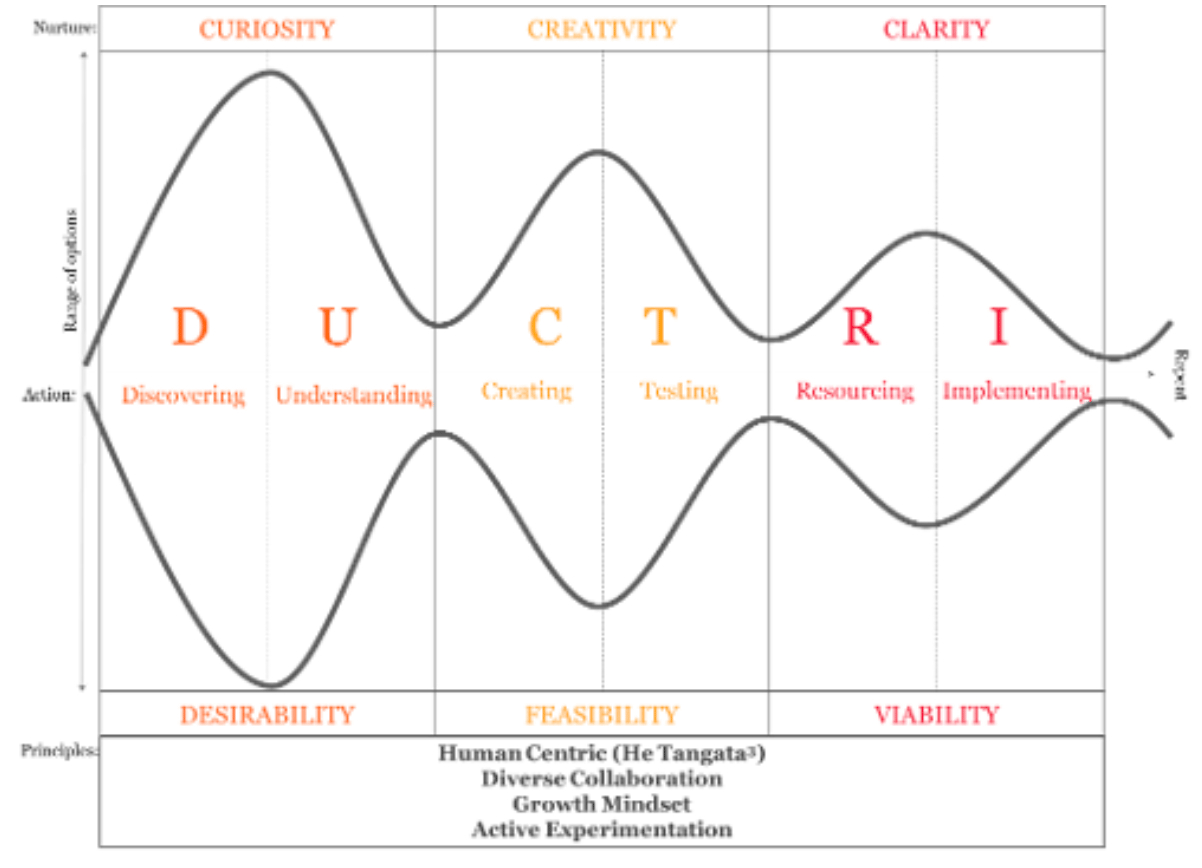
The DUCTRI model stands for: Discovering, Understanding, Creating, Testing, Resourcing, Implementing (plus Repeating).
The first four stages will be familiar to many, as they cover the curiosity and creativity side of things. But it's the final two stages where most frameworks fall short.
Resourcing and implementing aren't handover problems. They're design problems. They require the same human-centred thinking, the same creative rigour, the same curiosity about people and systems that you already bring to the front half.

So where do you start?
Here’s one place.
The Coalition Canvas
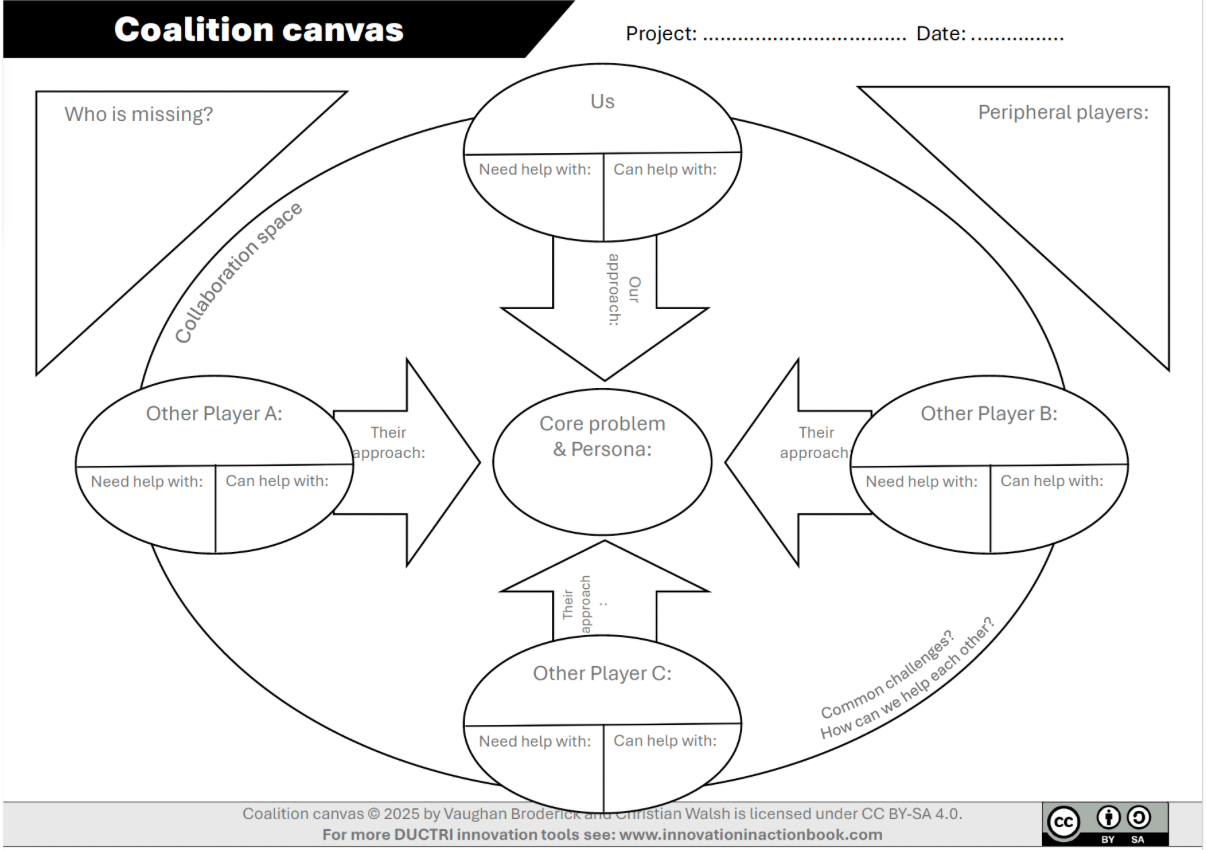
If your initiative needs more than your team can provide, but you're not sure who else to involve or how to get them genuinely on board rather than just informed, use this approach.
The Coalition Canvas maps the landscape around your initiative. Who else works in this space? What are they trying to achieve? Where do your goals overlap? You may be competing for the same scarce budget, leadership attention, or user goodwill without realising it.
The insight it surfaces is this: For complex problems, you don't want to launch something new that fragments support or confuses the people you serve. The tool helps you find allies, understand what they need, and build a coalition around genuine shared purpose - not just a stakeholder list to manage.
For example, in Canterbury's health system transformation, the coalition began with a small group of clinicians, consumers, and community leaders. They built around a shared persona - Agnes, an 84-year-old woman who represented everyone in the system's care. Everyone could relate to her. That connection became the unifying anchor. Over time, 3,500 people joined the showcase process. Then, 6,000 more participated. They built a social movement inside a cautious system - not through mandate, but through a deliberately designed coalition.
Try it on your current project. Draw the problem space in the centre. Map who else is active around it. Ask: What do they need? What do you need? Where could you be stronger together than apart? That question often reveals real blockers and enablers before you've wasted months finding out the hard way.
The person who walks into the planning meeting and asks 'who else belongs in this room?' is the person who just changed the conversation. For the leader accountable for the outcome, that question is the difference between an initiative that compounds and one that needs another post-mortem.
The Coalition Canvas is one place to start. But it sits inside something bigger.
Clarity of purpose - so your team is aligned around what actually matters before a solution is built. Clarity of communication - so the right story reaches the right people at the right moment. Open innovation - so you're drawing on the best thinking inside and outside your organisation. Crossing the chasm - so you understand the gap between early adopters and the mainstream and design for it deliberately. Building effective teams and shifting behaviour - because those are the human conditions that determine whether any of this sticks.
Innovation in Action was built with - not just for - practitioners. Danny is one of the expert contributors who helped shape it, bringing real-world thinking from the coalface of CX and EX innovation. Danny's contribution on idea selection alone is worth the price of admission. The result is a toolkit grounded in the kind of experience that doesn't just come from academic settings or consultancy decks.
It's the full playbook for turning ideas into impact. Built by people doing the work.
Your ideas are good enough. The process just needs to catch up.
Pre-order at https://innovationinactionbook.com/
Thanks to Danny and the Knot Another Newsletter community for the space to share this. If it resonates, I'd love to hear where your work is stalling and where it's flying.
Pre-ordering gets you more than a book: A sample chapter, free. Tool templates you can use immediately. Practitioner insight videos from contributors including Danny. Activation sessions with the authors.

Webinar 20th May
I will be a guest on a webinar hosted by Bayzat this weds title The HR subscription Model: Why your best people are quietly unsubcribing. I think the sign ups are closing tomorrow so if that sounds up your street you can register here

Thanks for reading if you’ve got thoughts to share just hit reply I always enjoy hearing from you Speak soon, Danny
How did you like today newsletter?
Login or Subscribe to participate

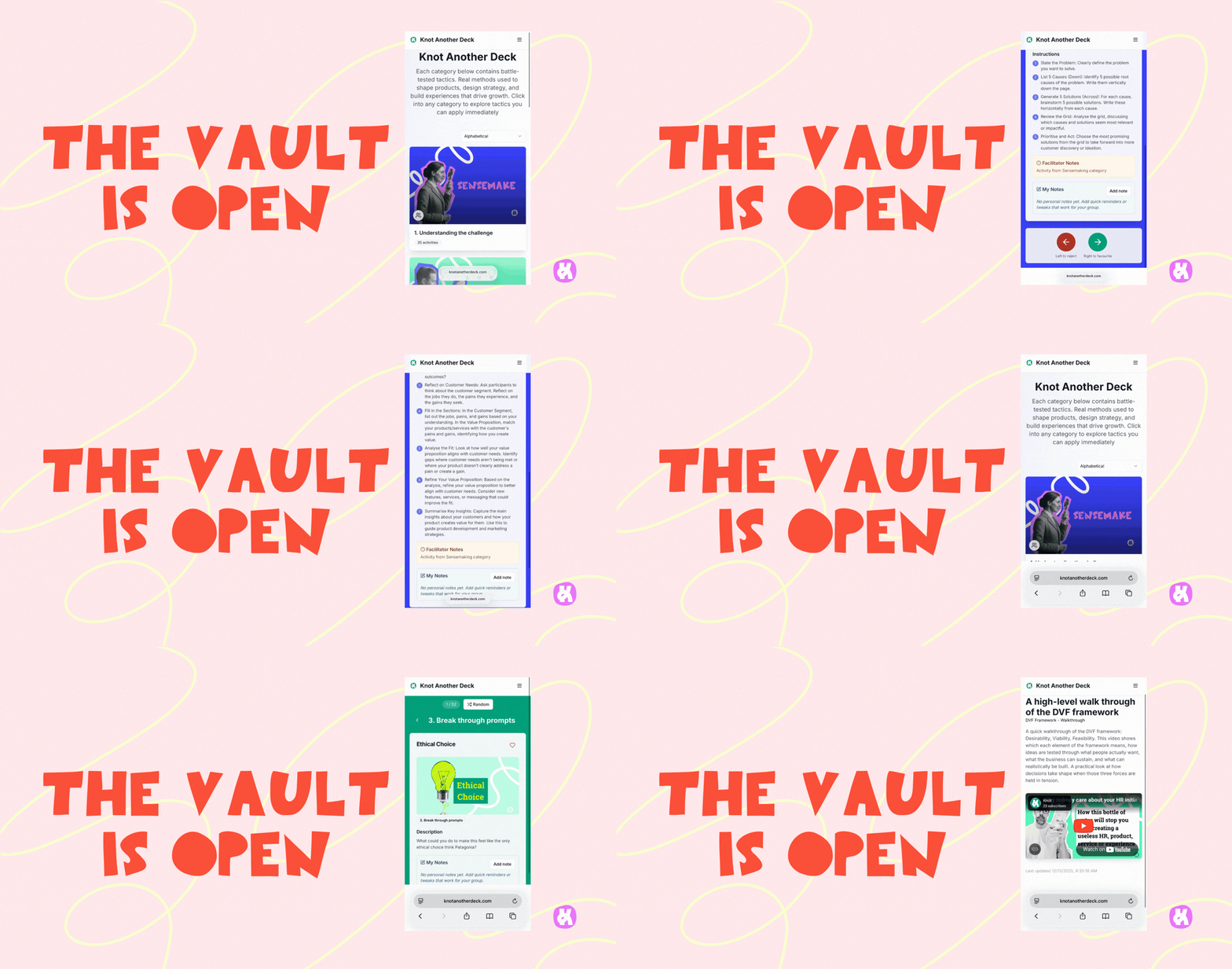
The vault is open: The same tools I used to drive transformation at Dyson and GSK now yours, free These tactics powered millions in innovation and CX wins.
NEW DECK: Landing this week
Want to know more about what we do, click here
