


Hey amazing people,
I'm writing this full of man flu and yes, before you say anything, it's absolutely a real thing. Women just call it a cold. Anyway, let's get into it. This one's a longer read, but its one ive been building toward for seven years.
Today's focus:
Why being right seven years early can feel like being wrong
The system problem hiding behind a $438 billion number
7 Red flags your HR/PX strategy is already cooked

TL;DR
People experience has always been a system problem, not a content or programme problem. Your people are subscribing to the experience of work, and every SPIES touchpoint is a renewal moment. This piece includes 7 red flags and 5 assumptions to check whether the system problem is already inside your organisation

Cassandras Curse
2019 What I saw coming
It's 2019. Organisations are pouring money into engagement platforms, learning content, and shiny employee experience projects. The language is optimistic, the intent is good, and nobody is doing any of it badly on purpose.
And I'm saying something far less comfortable.
The reason employee experience and L&D keep underdelivering has nothing to do with effort or intent, it's that organisations are designing for the wrong problem entirely. They're investing in content consumption, training sessions, and programmes using the same capabilities that got them here in the first place. The puzzle they're trying to solve has always been a system problem dressed up as a content problem, and it's only going to get more complex.
What they actually needed was a completely different lens to look at the experience of work and HR, one that looked at Strategy, Products, Interactions, Experiences, and Services, what I call SPIES. Design, product, and system thinking wrapped around a skillset based in experience and services design. The kind of ownership that comes from treating people's time as something worth designing for, not just filling.
If you were working in people strategy back then, you might remember the feeling. Something about the direction didn't sit right, but the language to challenge it didn't exist yet. A handful of people could see it. Most couldn't. That was the position I found myself in

The curse
There's a story from Troy most people know loosely. Cassandra was given the gift of seeing the future clearly. When she refused Apollo's advances, he cursed it: she would still see what was coming, but no one would ever believe her. When the Trojan Horse appeared at the gates, she warned them. When the city was about to fall, she warned them again. Nobody listened. They smiled, reassured themselves, and brought the horse inside.
She was right the whole time, and it made no difference.
That's a particular kind of lonely, the kind that comes from being right before anyone is ready to hear it. Being early doesn't look like insight from the outside, it looks like noise. And if you've ever sat in a leadership meeting knowing the strategy was solving for the wrong layer while everyone else nodded along, you know exactly what that feels like.
Those who listened in 2019 are ahead of the industry now.
Those who didn't launched the programmes, rolled out the platforms, created the content and unknowingly watched the horse make its way inside the city.


Its now 2026
Fast forward to 2026.
The horse is inside the building
If you've been investing in people strategy, people transformation, and employee experience for the past few years, you already know something isn't landing the way it should. The investment went in and the programmes launched, and yet the managers most organisations rely on are overloaded and stuck in a loop where every initiative adds complexity without removing friction. Purpose isn't missing because nobody talks about it, it's missing because the system around it was never designed to hold it.
Here's the thing most organisations still haven't grasped: people experience works like a subscription. Your people are subscribing to the experience of work. Every product, interaction, service, and experience across your PX/HR strategy is a renewal moment, a point where someone either quietly recommits or quietly disengages. People don't leave organisations in one dramatic moment. They stop renewing, one broken interaction at a time, and nobody notices until the pattern is already set.
The consequences are showing up in the numbers, poor experience and engagement across the organisation is showing up as an estimated $438 billion in lost productivity not because anyone stopped caring, but because the backstage systems that hold the people experience together were never built to match what the frontstage promised to customers, clients, and guests.
I've been running this work for seven years because nothing else was solving for the system layer, and that's still where the gap is. If you're a CPO or CHRO who's invested heavily and still watching the same patterns repeat, the issue probably isn't your people strategy itself, it's that nobody designed for what breaks it under pressure.

Seven red flags your cooked and the horse is already inside
You might not even need a full experience audit to see this, though what a proper diagnostic reveals usually runs deeper than anyone expects. If you recognise three or more of these in your organisation right now, the system problem is already visible.
Your managers can describe what they deliver but not why it matters to the people going through it. The operational layer is running, but nobody can articulate the experience it's supposed to create or the value it adds in terms of the time people are giving you.
Every new initiative adds a layer but nothing gets removed. Your people strategy has become an archaeology dig, and the teams on the ground are buried in it. None of it is aligned on a value chain, and nothing compounds because each initiative sits in isolation rather than building on the last.
Your engagement survey says one thing, your exit interviews say something completely different, or nothing at all. The measurement is capturing satisfaction, not the actual experience of work.
You've redesigned onboarding in the last two years and the first 90-day attrition rate hasn't moved. The programme changed, but the system around it didn't. New starters are still scoring their team experience low, which means the lived experience around them stayed exactly the same.
People across the business can name your values but not a single moment where those values shaped a hard decision. The culture thread is on the wall, not in the work.
Your transformation hit every milestone, yet the people it was designed for can barely remember it and was never part of the designing it. Delivery was complete, and the experience was forgettable by design and your people say nothing changed
When things go wrong, the system has no way to recover gracefully. The process was designed for the steady state, and real life isn't steady.
If you're sitting at four or five, that's the first punch…Now here's the second.
Why those flags exist, five assumptions keeping you stuck
The red flags above are symptoms, these are the assumptions underneath your strategy that are producing them. If any of these sound like how your organisation still operates, the system problem goes deeper than the symptoms suggest.
You still count headcount, not subscription health. Your planning and measurement architecture treats people as capacity to be filled. Workforce planning asks "how many do we need" rather than "how many are actively choosing us, and what does their renewal behaviour look like across every touchpoint."
Your value exchange is still time for money. The implicit contract says: give us your hours, we'll give you a salary. Everything else, culture, development, purpose, career, sits on top as a perk rather than being the core product your people are subscribing to. But if experience is a subscription, the product IS the experience of work, and pay is just one component of the value delivery.
You treat loyalty as a pay problem. When someone leaves, the first question is "did we pay enough?" Real subscriber loyalty looks more like superfans, people who stay because the total value delivery across every SPIES touchpoint compounds into something they can't replicate elsewhere. Pay plus purpose plus the quality of every product, interaction, service, and experience they touch.
You still talk about "the business" and "employees" as two separate audiences. But a CPO's people strategy IS a business strategy. The people subscribing to the experience of work are the same system that delivers the experience to your external customers. Two subscribers, one system, and the failures underneath are identical.
You measure with traditional KPIs instead of building a measurement engine. Engagement scores and annual attrition rates instead of something closer to how product teams measure their subscribers: Lifetime Experience Value, activation rates, renewal signals, churn prediction, and experience quality across every SPIES touchpoint. The measurement infrastructure most PX teams rely on belongs in a different era.
If the first set of flags showed you what's breaking, this set shows you why. The system problem isn't just operational, it's conceptual. The model most organisations are using to think about people experience was built for a world that no longer exists.
Wrap Up
well done you made it to the end
If you've made it this far, you're probably not someone who needs convincing that the problem exists. You've felt it. You might have been saying it yourself for years and getting the same polite nods Cassandra got.
What changes from here is what I'm writing about and who I'm writing it for. This newsletter is going to go deeper on the strategy and transformation layer that sits underneath people experience, and the capabilities needed to actually deliver it. The SPIES lens, the subscription model, the diagnostic tools, and the thinking needed to build teams and functions that can do this work, not just understand it.
If you're a CPO, CHRO, CEO, or people leader who's invested in transformation and knows something still isn't landing, this is where that conversation happens.
The smoke was visible in 2019 and it is now, the question now is whether you’re still reassuring yourself the horse is a gift

Thanks for reading if you’ve got thoughts to share just hit reply I always enjoy hearing from you Speak soon, Danny
How did you like today newsletter?
Login or Subscribe to participate
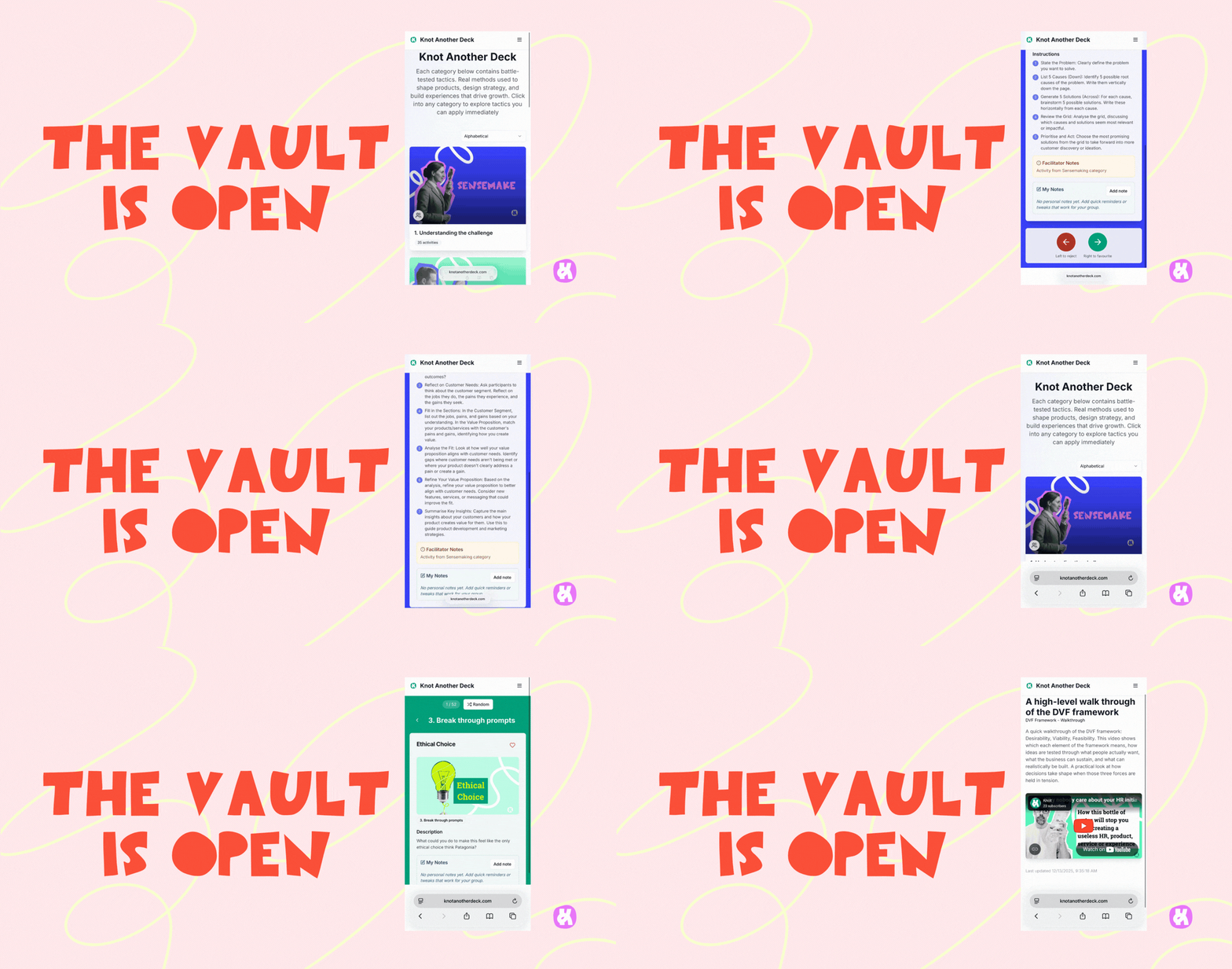
The vault is open: The same tools I used to drive transformation at Dyson and GSK now yours, free These tactics powered millions in innovation and CX/EX wins.
NEW DECK COMING SOON

Want to know more about what we do click here